Who this applies to
This applies to self-hosted KurrentDB, including deployments managed with our Kubernetes Operator. If you run on Kurrent Cloud, nothing here affects you.
Licensing changes are coming to KurrentDB, starting with 26.2, which we expect to release in Q3 2026. Because this may affect your upgrade planning, we want to give you and your organization an early view of what is changing and enough time to review it.
Some details are still being finalized and we will confirm them before the release.
In short
- From 26.2 onwards:
- Require license:
- Multi-node clustering,
- read only replica,
- archiving,
- encryption in rest
- Becomes free:
- All other features that need a license in the past
- Require license:
- For 26.1 and earlier:
- Nothing changes. Those versions keep the same feature and stay supported for their full LTS term
Free and Enterprise
Until now there have been three self-hosted KurrentDB editions. Free, Build and Scale, each with a different set of features.
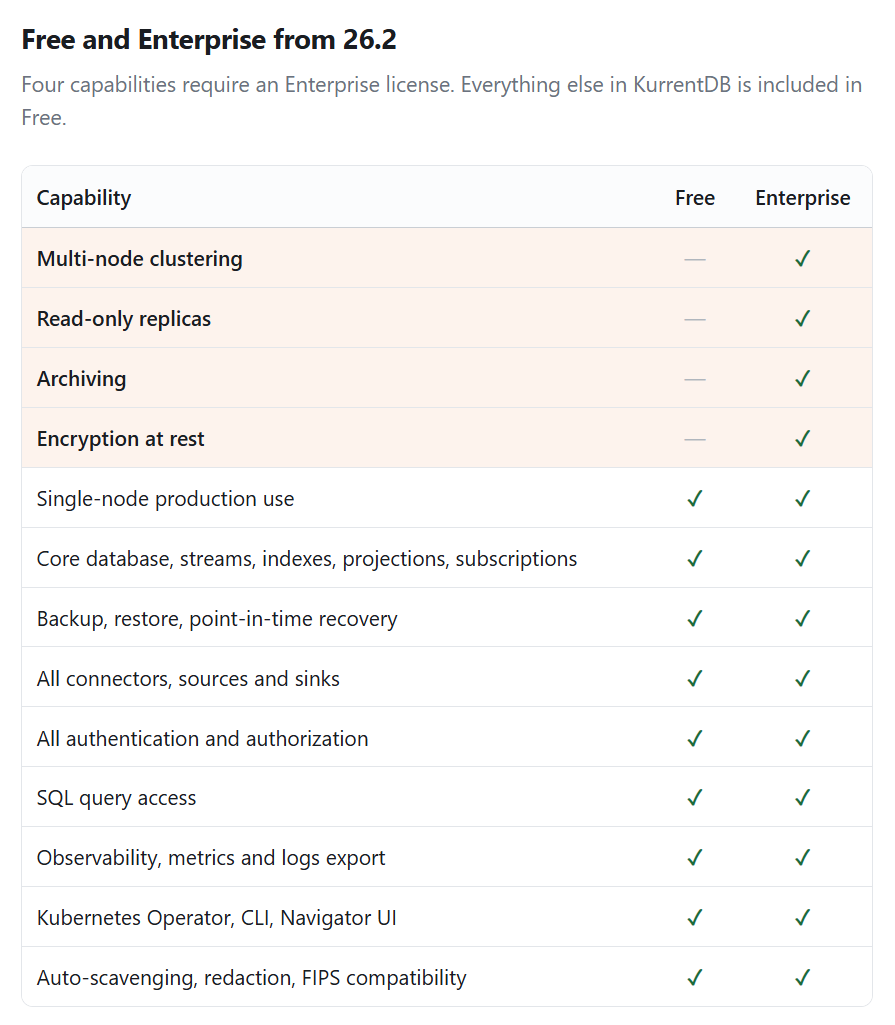
From 26.2 there will be two. Free and Enterprise. An Enterprise license is required for multi-node clustering, read-only replicas, archiving and encryption at rest. Everything else is available in Free.
KurrentDB 26.1 and earlier are unaffected
Every version of KurrentDB available today, up to and including 26.1, is licensed exactly as it is now and will stay that way. Clustering remains free on those versions. Each stays officially supported for its full LTS term and continues to run after that term ends, without patches or support.
We are not applying this change retroactively. There is nothing you need to do to keep your current deployment running as it is.
From 26.2, multi-node clustering requires a license
From 26.2, running KurrentDB across more than one node requires an Enterprise license.
That covers high-availability clusters and read-only replicas, since a replica runs as part of a cluster.
Single-node deployments remain free and fully capable of running production workloads. That includes backup, restore and point-in-time recovery. Running KurrentDB and protecting your own data does not require a license.
Archiving and encryption at rest also require an Enterprise license. Both are licensed today, so nothing changes for them.
What's changing underneath clustering
Clustering in KurrentDB has run on an implementation of Paxos for most of the product's life. That implementation was originally a commercial feature, and was later made available at no cost.
In 26.2 it is replaced. Raft is a modern, well-specified consensus algorithm with a large body of production use behind it, and moving to it gives KurrentDB a more robust leader election protocol than the Paxos-derived one it replaces. It also gives us a foundation to build on — several capabilities we want to add next depend on having it in place.
Raft is a new feature, and new features are part of the licensed edition. Because it replaces the previous protocol rather than running alongside it, the older implementation is retired in 26.2. That is why multi-node deployments from 26.2 onwards require a license.
From 26.2, most licensed features become free
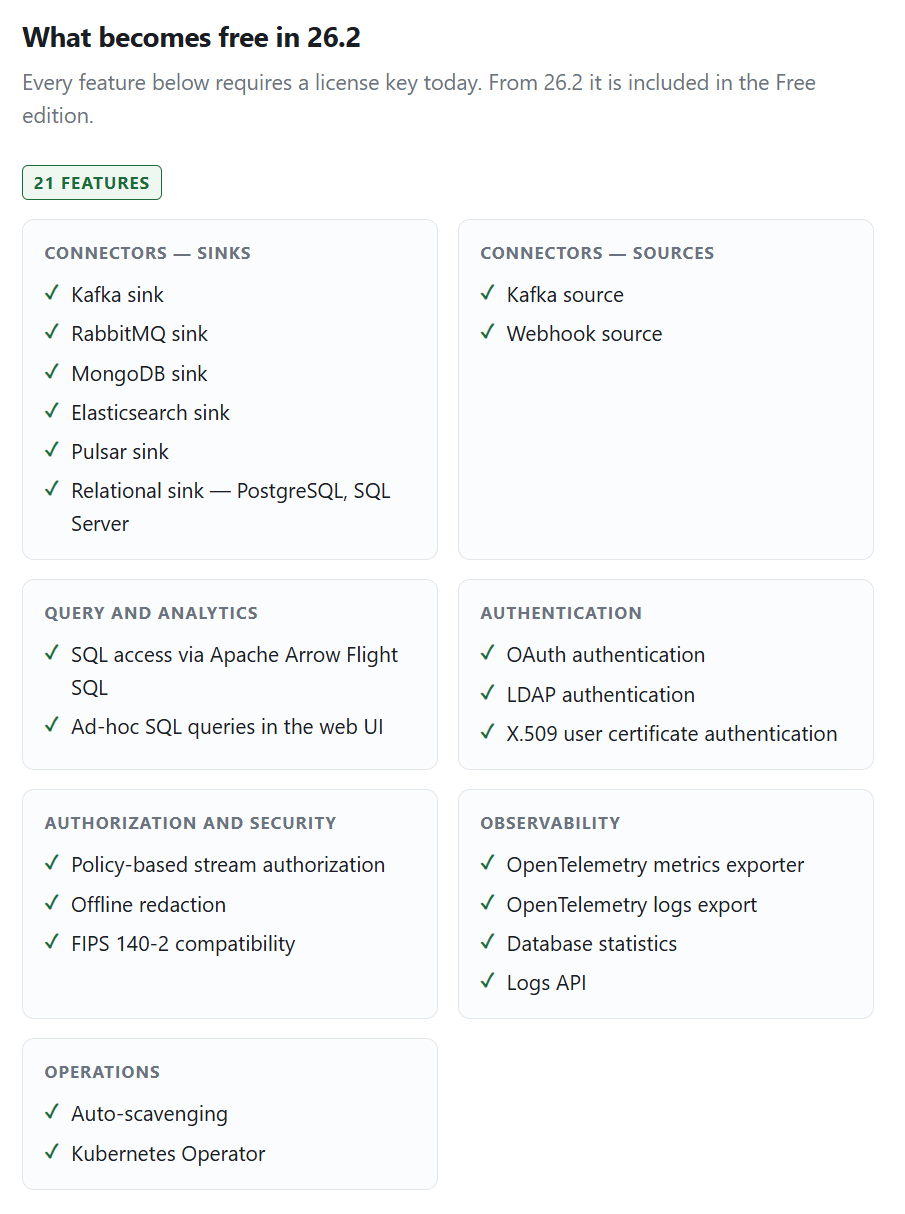
Everything below requires a license key today. From 26.2 it is included in the Free edition.
Connectors, sinks
- Kafka,
- RabbitMQ,
- MongoDB,
- Elasticsearch,
- Pulsar, and
- Relational sink for PostgreSQL and SQL Server
Connectors, sources
- Kafka source and
- Webhook source
Query and analytics
- SQL access via Apache Arrow Flight SQL, and
- ad-hoc SQL queries in the web UI
Authentication
- OAuth
- LDAP and
- X.509 user certificate authentication
Authorization and security
- Policy-based stream authorization,
- Offline redaction,
- FIPS 140-2 compatibility
Observability
- OpenTelemetry metrics exporter,
- OpenTelemetry logs export,
- Database statistics,
- Logs API
Operations
- Auto-scavenging and
- Kubernetes Operator
If you run a single node, 26.2 is a straightforwardly better release. You gain all of the above and nothing you have today is taken away.
What this means for you
If you run a single node.
Nothing to do. When you upgrade to 26.2 you gain everything listed above, and nothing you have today is taken away.
If you run a cluster and stay on your current version.
Nothing changes. It keeps working exactly as it does today, clustering included, and stays supported for the full term of your release. After that term ends it continues to run, but without patches or support.
If you run a cluster and want to upgrade to 26.2 or later.
You will need a license key. We are still finalizing exactly how that is enforced at startup, so please treat having a key in place as a prerequisite for the upgrade rather than something to sort out afterwards. We will confirm the specifics before 26.2 is released. If you need time to decide what you want to do, ask us for a trial key and we will issue one.
If you already license KurrentDB.
Your agreement doesn't change and there is nothing to renegotiate. On 26.2 you gain the features moving into the free tier, and multi-node remains available to you as it is today.
If you are deploying multi-node for the first time on 26.2 or later.
You will need a license. Talk to us about it, or start with a trial key if you would rather evaluate first.
If you would rather not run high availability yourself.
Kurrent Cloud runs clustered KurrentDB as a managed service and is available today.
If you are already on Kurrent Cloud.
Nothing changes for you.
If you are an early-stage startup or a small team.
We are putting together discounted bundles and will publish the details before 26.2 ships. Get in touch in the meantime.
Why we are making this change
KurrentDB is distributed as a single package that anyone can download and run. The core database is free, and a set of additional features is switched on with a license key. That arrangement doesn't change in 26.2, and neither do the license terms. What changes is which features need the key.
That decision was made in September 2024, when we introduced the license key. We wanted the model to make licensed features straightforward to obtain, to keep our source open for anyone to read, and to fund continued investment in the product.
Underneath those goals was a simple idea. As a business grows, its use of the database grows with it, and what it pays should follow. We built that in two ways.
1. The price scales with the capacity you run, measured per vCPU.
2. The features placed behind the license key were chosen to represent what an organization needs once it is operating at scale.
Two years on, the first has worked as intended. The second has not.
The features we chose turned out not to be signals of scale at all. Connectors, authentication, authorization and observability are things small teams need just as much as large ones, and large teams frequently already have their own tooling for integration and monitoring. So a license never became something they needed to reach for. A company could run KurrentDB for a substantial commercial workload and have no particular reason to license it, because what they needed was already free and what was licensed wasn't what they were missing.
Clustering had itself been a commercial feature earlier in the product's life, before being made freely available. With hindsight, moving it out from behind the license while putting integrations, authentication and observability behind it was the wrong way round.
In 26.2 that consensus layer is replaced. Raft is a modern, well-specified algorithm with a large body of production use behind it, and moving to it gives KurrentDB a more robust leader election protocol than the Paxos-derived one it replaces. It also gives us a foundation to build on, since several capabilities we want to add next depend on having it in place. Because Raft replaces the previous protocol rather than running beside it, the older implementation is retired in 26.2, and there is no free clustering build left to keep.
What does reliably indicate scale and criticality is running on more than one node. Multi-node deployments aren't run to explore the product. They're run because an outage has become a business incident.
So the principle we are settling on is this.
The free tier should include everything needed to build, secure, integrate and operate KurrentDB, including running it in production on a single node with your data safe. What requires a license is multi-node operation, and the licensed features fund the development, patching and long-term support of everything around them.
Questions
Do I need to do anything now?
No. Nothing changes until you upgrade to 26.2 or later. If you run a cluster, the one useful thing to do early is talk to us , so a license key is in place before you need it.
What happens if I upgrade to 26.2 with a cluster and no license key?
You will need a key for a multi-node deployment. We are still finalizing exactly how this is enforced at startup and will confirm the specifics before release. Until then, treat the key as a prerequisite for upgrading rather than something to resolve afterwards.
Can I stay on 26.1 indefinitely?
Yes, and it keeps clustering. Be clear about the trade. Once your release reaches the end of its LTS term you would be running a database without security patches or support. That is your decision to make, and we would rather you make it with the facts.
Why is multi-node the licensed capability?
It is the most reliable indicator that KurrentDB is running something commercially important. Nobody runs a cluster to explore the product. Single-node, including single-node in production, stays free. It is also where a number of other databases draw the same line, including Neo4j, Redis, RavenDB and Axon.
What about read-only replicas?
A read-only replica runs as part of a cluster, so it falls under the same license requirement. There is no separate replica license.
Is there a free tier for development or test clusters?
No. Multi-node requires a license regardless of environment. We can issue trial keys for evaluation and development work, so ask us rather than assuming you are stuck.
How much does an Enterprise license cost?
It depends on your deployment, and pricing for the new editions is still being finalized. Get in touch and we will give you a figure for your situation.
Is there anything for startups or small teams?
Yes. We are finalizing discounted bundles and will publish the details before 26.2 ships. Get in touch in the meantime.
Why can't the Free edition keep the current clustering implementation?
The Paxos-derived protocol is retired in 26.2, replaced by Raft. We're not maintaining two consensus implementations in parallel, so there is no free clustering build to keep. Raft is a new feature and sits in the licensed edition, as new features do.
Was clustering always free?
No. The Paxos implementation behind clustering was originally a commercial feature and was later made available at no cost. Raft, which replaces it in 26.2, is licensed.
Can I evaluate clustering before committing?
Yes. Ask us for a trial key.
Does this change the license terms?
No. The Kurrent License is unchanged, and so is the way the license key works. What changes is which features the key applies to.
Does this affect Kurrent Cloud?
No. Cloud customers are unaffected.
The Kubernetes Operator becomes free, but it deploys clusters. Does using it require a license?
The Operator itself is free. The clusters it deploys require an Enterprise license, as any multi-node deployment does.
Summary
Multi-node clustering requires an Enterprise license from 26.2 onwards. Single-node deployments stay free and gain most of what used to be licensed. Nothing changes for 26.1 and earlier, which stay supported for their full LTS terms, and nothing changes for Kurrent Cloud.
Before 26.2 is released we will confirm the exact upgrade and enforcement behaviour, publish the pricing and the startup bundle details, and update the feature matrix in our documentation. If anything in this post changes between now and then, we will say so here.
Contact us
If you run a cluster today and expect to upgrade, the useful thing to do now is get in touch, so a license key is in place before you need it rather than after.
You can reach us at kurrentdb.kurrent.io/contact-us .
If you already license KurrentDB, you can also speak to your account executive directly.